
Call Pete & Joanne
+1 (862) 222-0442 (EDT)

Photo: Ruins at the site of Lavrion
Long before Athens had walls or ships, the earth beneath Greece was under great stress and pressure.
For 50 million years, the African tectonic plate pressed northward, sliding beneath the Aegean, grinding stone against stone until solid rock cracked and melted under the stress. Deep within the earth, metals were loosened and carried upward by unseen currents.
Eventually, just southeast of Athens near a fishing village called “Lavrion” the land cracked just enough to reveal its gift ... silver!
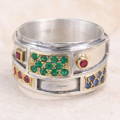

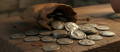
The introduction of the Athenian Tetradrachm (the "Owl") stands as a watershed moment in human history.
Although it was not the first coinage (that honor may go to the nearby Lydians), it earned international respect for its quality and uniformity. Whether traded at home or deep within the Persian Empire, it was trusted as a medium of exchange. In its travels it also announced the growing power of a tiny but ambitious city-state known as Athens.
But why make them from silver? Why not bronze, gold, or iron?
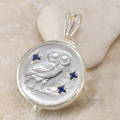
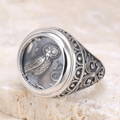
In The Iliad and Odyssey, Homer offers insight into the use of silver prior to the Greek Dark Ages. Silver was often used to elevate everyday objects into luxury items such as cups and bowls, inlays on sword hilts, and, of course, jewelry. This aligns with what we know about the extraction and smelting technologies of the time, which were well suited to working silver from ore. Indeed, silver was used for rings and bracelets in Greece as early as 3000 BC.
Through its use in jewelry and other high value items, silver became an established luxury item, and with that came a certain gravitas and shared perception of its value. Its transition to a trade item became the logical next step. Tributes, ransoms, and exchanges were conducted using silver items such as jewelry and bowls. The problem, of course, was practicality; every transaction required weighing the silver, and what if you only needed half a sword hilt to settle a debt? (awkward!)
Coins provided a medium of exchange that was independent of both the craftsmanship costs tied to luxury objects and the ever-present disputes over their artistic and functional value.
In short; coins made trade easy and helped economies grow. But without a trusted metal backing them up, they would not have been trusted. So when the Athenian Owl came along with its high quality silver, it truly changed the world.
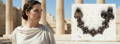
Photo: Fibulae were typically made of bronze, but also crafted in silver to display status. They were used to fasten cloaks and later evolved into the modern-day brooch. This brooch can be found at the Metropolitan Museum of Art. The AI image was generated to visualize its use.
Homer mentions silver in deliberate and symbolic ways, often as a marker of civilization, order, and legitimate wealth.
One example appears when Telemachus, the son of Odysseus, journeys to Sparta to consult King Menelaus for help and advice. While there, the king presented him with a silver krater to formalize a sacred relationship between the royal households, a bond of recognition within the civilized world.
In Homeric society, worked silver vessels played a symbolic role: valuable, durable, and unmistakably elite, yet neither vulgar nor transactional.
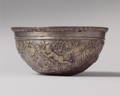
Photo: A krator was essentially a mixing bowl. This one was made in Sterling Silver in the repoussé technique. This one is from the Hellenistic period and can be found at the Metropolitan Museum of Art in New York.
The ancients valued metals in more than just material and economic terms; metals also carried cosmic associations. For instance, gold was linked to the sun and silver to the moon.
Silver was also associated with distance, purity, clarity, and restraint. In comparative terms, it favored reflection over radiance, and precision over abundance.
Photo: Artemis was the patron goddess of silver, the moon, hunting, the wilderness and childbirth. Her bow and its arrows were made from silver to reveal secrets in the darkness and kill quickly without decay.

Large cities had temples for all the major gods so that people could worship as desired. People would reflect on their needs and find the appropriate god’s temple or shrine to pray to.
Many worshiped the patron god of their city (such as Athena in the case of Athens) out of civic allegiance. It was also common to pray for more personal reasons: to Artemis or Hera when expecting a child, to Poseidon before a sea voyage, to Zeus for justice, or to Apollo for truth and clarity.
For Hindus, this idea may sound familiar, as different gods are honored for different purposes. Even in Catholicism, people often pray to God through specific saints—such as St. Christopher for safe travel or St. Jude in desperate circumstances. The notion of directing prayers to a divine specialist, it seems, has endured well into the present day.
Silver’s association with honesty and purity made it an obvious choice as an offering when seeking divine favor. This was especially true when addressing Artemis and Apollo, and it helped ensure their importance throughout Greece. Silver offerings might take the form of cups or bowls, jewelry, figurines, or, later in history, coins.
But what happened to the silver that was left at the altar? Some of it remained at the shrine. If an item was deemed the property of the god being worshiped, it was left untouched. This often included figurines bearing the god’s name or objects tied to the fulfillment of a vow. The remaining offerings were recast and used to support religious infrastructure, maintaining temples, paying priests, and funding sacred feasts and festivals.

In 498 BC the Athenians helped several friendly states rebel against Persian rule. In the process they destroyed the Persian city of Sardis, an offense so shocking to King Darious that for the next 8 years he had a servant whisper in his ear, “Remember the Athenians”.
And so it was that in 490 BC the Persians landed 26 miles Northeast of Athens at a place called Marathon. The Persians brought 25,000 soldiers, the Greeks brought 10,000.
The Persians expected victory. They should not have.

The Athenians won the battle, but deep down they knew it was not over. The Persians were the wealthiest, most powerful empire on earth and they had been humiliated. They would return.
For the next several years a growing sense of dread spread across Greece. A fear so great that it fractured alliances. City states such as Thessaly, Thebes, Argos and Aegina re-aligned with the Persians rather than face destruction. The Athenians and Spartans held firm but without a strong navy they stood virtually defenseless. After all, the Persian attack at Marathon demonstrated their ability to land virtually anywhere in Greece (a decisive advantage).
At most, the Greeks had 70 triremes (the fighting ships of their day). This was not enough to patrol the coastline around Athens, let alone the whole of Greece. On top of that, triremes were expensive to build and required large crews of trained rowers. In short; things did not look good for the Greeks.
But then, in 483 BC an exceptionally rich vein of silver was discovered. The ore was denser, easier to process and plentiful enough to finance the construction of over 200 new triremes.
Much has been said of the Spartan’s stand at Thermopylae, but it was actually a coordinated “combined arms” defense.
The Athenian navy was nearby at Artemisium, where it prevented the Persians from outflanking the Spartans by sea.
Ultimately the Persians got past the Spartans and went on to burn Athens to the ground. The Athenians themselves had evacuated to the nearby island of Salamis where the decisive battle of the war would occur.
A naval battle that has been compared in importance to Trafalgar and Midway would ensue, and be won decisively by newly built Greek triremes.
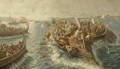
Lacking a navy, the Persians could not resupply their army which was now stranded on the Greek mainland, and in the following summer an army of Greeks led by Sparta faced and defeated the hungry and poorly supplied remains of the Persian army at Plataea.
The importance of silver to the Greeks was undeniable. Although the metal was worthless as a weapon, it secured Greek independence. As such, its meaning to the Greeks (and their jewelers) is revered to this day.
Victory over the Persians ushered in an unparalleled period of prosperity. Advances in science, medicine, philosophy, and artistic freedom emerged that still shape our world today.
Ironically: The “Golden” Age was powered by silver. A metal revered by the gods for its purity and divine order (and which the Greeks had in abundance), making for a perfect blend of social intention and financial ability.
Architecture and the arts became expressions of civic confidence and moral order. Nowhere is this clearer than on the Acropolis, where monuments like the Parthenon, Propylaea and Erechtheion transformed a sacred hill into a statement of Athenian leadership.

The same ideals shaped sculpture, pottery, metalwork, and jewelry. In public theaters, drama fused art, religion, and politics, forcing citizens to confront questions of power, justice, and fate. Balance and social justice were the ideal, silver and marble were the medium.
Of all things, the Athenian navy is most often credited as a source for the world’s first democracy.
The abundance of silver meant ships could be constructed, equipped, and launched at scale. But once in the water, a new problem emerged: thousands of rowers were needed to propel the fleet. These men were not slaves, but citizens who risked their lives at sea, and having done so, demanded a voice in how the city was governed.
Volumes have been written on how democracy “happened” from there, but if silver made victory possible and it stood for justice and social order, one could imagine the people using this belief to influence their path forward. Suffice to say: the people got what they wanted and a democracy was born.
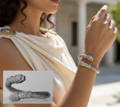
When the Greeks won, they celebrated as a society, but as individuals they often did it with jewelry - such as these two bracelets.
The first has Persian influences: A wrap-around cable bracelet with lion-head caps would have benefited from earlier middle-eastern designs.
The second a bracelet design with filigree applied to a silver base, serpent designs on the sides and a pearl.
Photo: We've used AI models to show these bracelets "in action" (the real ones can be found at the Metropolitan Museum of Art in New York).

When citizens are given the power to claim ownership of their future, remarkable things can happen. The freedom to create and express becomes a force that pushes a culture forward on all fronts.
It has been said that laws tell us what we can not do, but religions tell us what we should do. Through silver (which served both a religious and financial purpose) we saw this principle at work at a pivotal moment in history.
Speaking of “the people”: It is our view that archaeological treasures belong to the people who created them. Of particular concern are the portions of the Parthenon currently held by the British Museum.
Having witnessed Greek people moved to tears before these works, we can say with confidence that they are not “Elgin’s Marbles,” but part of a culture’s beating heart. We encourage the British Museum to do the right thing and return them to Athens.
Defeating the Persians ignited Greece’s Golden Age, but with no external threat to holding them together, old rivalries between city states resurfaced and peace gave way to discord.
It would take another force to unite the Greeks, a force that came from the North in the form of Philip II of Macedon and his son, Alexander.
We could easily get sidetracked talking about Alexander, but this is the story of silver so we’ll reduce his story to just one sentence:
“Confidence goes a long way.”
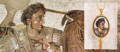
Photo: On the floor of the house of Faun in Pompeii lies a mosaic depicting Alexander the Great leading a cavalry charge at the battle of Issus. Luigina Rech’s masterful rendition in micro-mosaic is on the right.
A transformation of luxury
While wandering about Asia, the Macedonians discovered gold (mostly in Persian vaults). Precious metals had been accumulating there for hundreds of years and now it was Alexander’s for the taking. Across the Greek world this led to an explosion in luxury goods. Jewelry became larger, more intricately crafted and for the wealthy; infused with gold.
Silver, the metal of modesty and purity … was getting a demotion.
The affluent and middle classes emerged
The expansion from city-state to empire expanded the range of social classes as well. Bureaucrats, military officers, engineers, tradesmen, teachers and artists were required to build and maintain the society being created. Although gold rose in prominence, it was enjoyed mostly by the aristocracy. Silver was still the noble metal of the people. It’s perception of value was maintained every time a silver coin was minted and wearing it as jewelry was a statement of prosperity, without excess.
A note on the Romans:
The Greek Hellenistic Period ended when the Romans took over, but many Hellenistic values continued without change (in regards to jewelry at least). The class aspects did soften to a degree, and use of both silver and gold in jewelry achieved a smoother blend up and down the economic strata, but the Romans, like the early Greeks
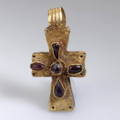
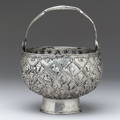
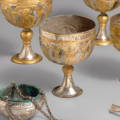
Byzantine style is easy enough to understand:
Begin with utility, layer on extravagance, and if there’s any room left … indulge it with decadence!

Photo above: Constantine positioned his new capital on a peninsula overlooking the Bosporus Strait, making it one of the most strategically placed cities in history. Trade brought immense wealth, and its legendary walls helped the Byzantine Empire endure for nearly 1,100 years after the fall of Rome.
The social and economic structures that developed during Alexander’s Hellenistic age continued through Roman and Byzantine times. Gold maintained its primacy as a symbol of status, while silver remained the foundation of currency as well as a luxury metal in its own right.
Editorial note: At this point, our history of silver must briefly incorporate a substantial dose of gold in order to explain a style of jewelry that would later appear in silver.
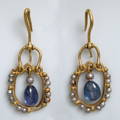
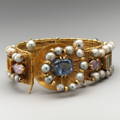
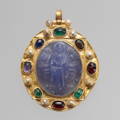
Understanding Byzantine Style
The empire’s trade routes stretched from China to Spain, and from Scandinavia to the eastern coast of Africa. This vast network funneled enormous wealth into Constantinople, making it one of the richest cities in the world.
Trade brought such prosperity that extravagance became almost competitive. With each successive generation, artists and craftsmen sought to outdo their predecessors, not only in skill, but in the richness of the materials they employed. Gold, gemstones, enamel, and intricate metalwork were pushed to new levels of refinement, giving rise to the distinctive opulence that would come to define Byzantine art and jewelry.
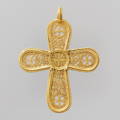
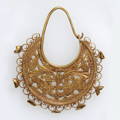
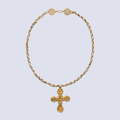
The “Byzantine style” is typified by an extremely ornate look realized in finely detailed metal work and/or extensive incorporation of stones.
Byzantine Influence in Today’s Designs
Although Greek jewelry designers draw inspiration from many periods of history, they most strongly identify with the Byzantine style. Occasionally, a designer may recreate a historical piece quite literally, but more often the influence appears as an artistic evolution, taking the spirit of Byzantine design and developing it into something entirely new.
The result is jewelry that feels both ancient and contemporary at the same time, carrying forward the craftsmanship, symbolism, and richness of a tradition that has endured for centuries.

Above: A scene from Athens overlooking the temple of Hephaestus (foreground left), Mount Lycabettus, and the Acropolis. During the Ottoman occupation Greeks were rarely allowed to gather in large groups except during religious festivals. This resulted in … you guessed it; more religious festivals!
Around 900 AD, Turkic tribes from the steppe north of the Aral Sea began moving west and south toward Persia and the Middle East. Pressure from other nomadic groups, along with opportunities in Islamic lands, encouraged this migration. Over time they expanded into Persia, Iraq, and Anatolia, eventually capturing the city of Constantinople in 1453.
As conquerors, the Turks were not known for their benevolence … social humiliation and economic domination were among their tools of control. We will not delve deeply into the details, but it is worth noting that conditions for the Greek population were harsh, and resentment exists to this day.
Two Ottoman restrictions were particularly impactful to the story of jewelry making, and silver in particular:
How did these limitations affect Greek jewelry?
Two things often noticed about Greeks are the number of religious holidays they celebrate and how they identify where they are from (not just “Greece” but also a particular island or village).
The restriction on non-religious congregation simply led to the Greeks have more holidays, and with more enthusiastic participation in them as well. This strengthened communal bonds and deepened ties to the local church, making a person’s village a critical part of their personal identity.
The restriction on gold had an obvious effect. The craftsmanship skills developed during Byzantine times simply found new expression in silver. If you’re impressed by the intricate silverwork on our site, much of that tradition was refined during this period.
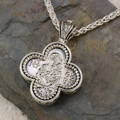
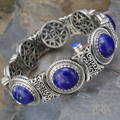
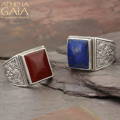
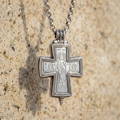
Identifying Ottoman Era pieces in the store
Look for very intricate silverwork executed in one of three ways: Mostly in the form of a cross or saint as this was allowed by the Ottomans, but also religious based folk art.
Lapis, coral, turquoise, carnelian, and mother of pearl were commonly used stones during the occupation. They were plentiful, relatively easy to work with, and generally speaking, untaxed by the Ottomans.
After Greece regained its independence the “Byzantine Three” (emeralds, sapphires, and rubies) started to find their way into highly detailed silver pieces - a sign of things to come in our next newsletter!


When jewelry carries
a memory of its own,
it becomes worthy
of ours as well.

The Greeks have always had a strong ethnic identity, but liberation from the Ottomans added a spirit of national identity they hadn’t felt since the time of the Byzantines.
World wars, civil conflict and poverty would not make their first century of independence easy, but the Greeks were good at “difficult”. Not even a Nazi occupation couldn’t tramp out their artistic will.
Children still needed to be baptized, loved ones needed to be decorated and a tradition needed to be maintained. So in small family workshops they kept working their silver … just to survive … just to feel human.


“We travel not to
escape life
but for life
not to escape us.”
-Robyn Yong

As the global economy of Post WWII recovered, “vacations” once again became possible. People wanted to experience the “Grand Tours” of Europe and the newly designed Boeing 707 was ready to take them - the world was open!
Many went to Paris or Italy, but some traveled a few hours more to see the Parthenon and the islands. When the sun warmed their souls, and the food filled their tummies a certain ancient magic took hold. A dip in the water, a smile from their host and a sip of wine sealed the deal.
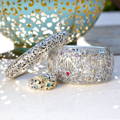
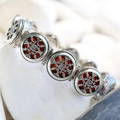
While wandering the narrow streets, they found something else:
A memento, a sign of faith, or an ornament for a loved one made of silver.
They recognized its quality, and as demand grew, six hundred years of mere “survival” came to an end and an ancient tradition was free to breathe again.
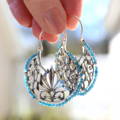
The reaction from travelers allowed jewelry designers to assess their options. Some looked at modern trends for inspiration, but many looked backwards instead, not out of nostalgia, but with intent.
They asked: What did we lose? What did we simplify? What did we forget how to make? They studied their past and decided to pick up where they had left off, developing new variants of their own historical styles.
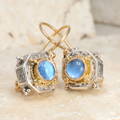
Our own Spiros Gerochristo pioneered the fusion of
18k Gold with Sterling Silver
while interpreting Byzantine,
Classical and Hellenic design.
His two-toned inspiration has now been used by jewelers all over the world.
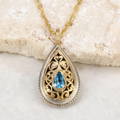
In a Greek home, nothing is rushed, careless, or given without meaning. Guests are welcomed, and the table is prepared with pride and an open heart.
The same is true of Greek jewelry and of the silver that has traveled the journey alongside it. It is not made to shout, but to be worthy of being worn, kept, and passed along to daughters, sons and grandchildren.
Beauty is not in shining surfaces or intricate details. True art honors strength, and within every piece of silver is a quiet respect for human perseverance and the belief that no matter how difficult things become, we can still stand up and take a step forward.